
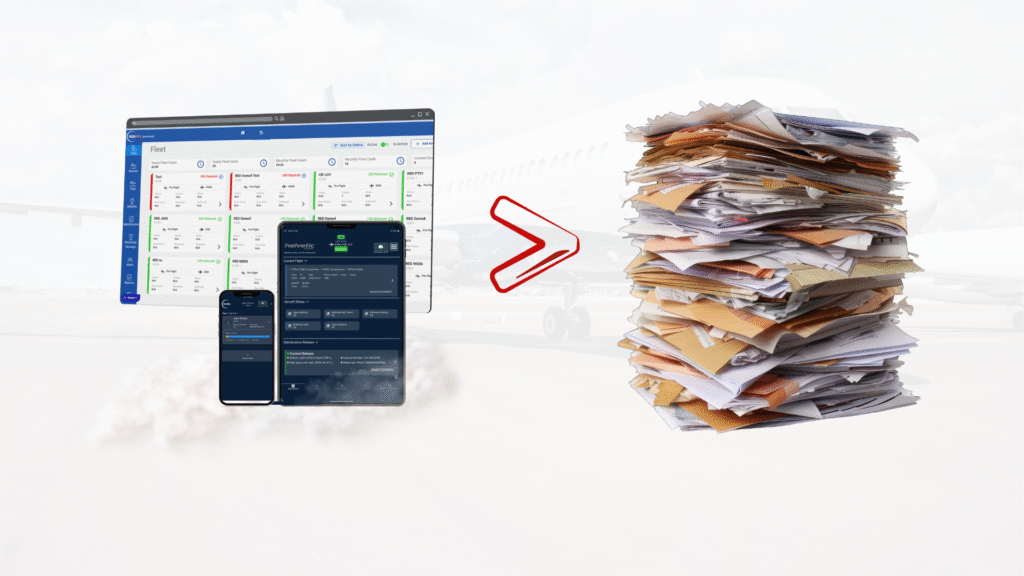
Paper technical logs remain in use across many operations, not because they are effective, but because they are familiar.
In most cases, they do not fail in obvious or dramatic ways. Instead, they introduce small delays, blind spots, and workarounds that quietly increase cost and reduce operational control. Over time, those inefficiencies compound across maintenance, CAMO, dispatch, and flight operations.
The real cost of paper technical logs is not necessarily the cost of paper, printing, or storage (although these do add up). It’s the lost time and the decisions teams are forced to make without up-to-date, reliable information.
As operators seek to enhance predictability and planning, many are reevaluating the value of an electronic technical logbook.
Lost Visibility Is a Real Operational Risk
Operational control depends on visibility. When aircraft status is clear, decisions are deliberate and planned.
Paper logs trap critical information in the cockpit or maintenance office until someone manually moves it. As a result, Operations Control and Dispatch are often forced to rely on phone calls, emails, or informal messages to bridge the gap, because waiting for the logbook is simply too slow.
In practice, this loss of visibility typically shows up as:
Aircraft scheduled without full awareness of open defects
Technical issues surfacing late in the turnaround
Last-minute aircraft swaps that could have been avoided
Decisions made using partial or outdated information
The longer it takes for defect, maintenance or safety and compliance data to reach the people responsible for operational decisions, the harder it becomes to plan effectively. Even in well-run operations with experienced teams, delayed information reduces predictability and forces your team into reactive decision-making.

How Paper Technical Logs Undermine Maintenance and CAMO
For maintenance and CAMO teams, paper technical logs delay information and degrade its quality.
Handwritten entries are often incomplete, inconsistent, or missing context. By the time defects are transcribed into digital systems, details are lost, assumptions are made, and the original operational picture is already blurred.
Over time, this leads to familiar outcomes:
- Repeat defects that are harder to identify and trend
- Unreliable defect history across aircraft or fleets
- Maintenance teams are cleaning data instead of analysing it
- An increase in no-fault found maintenance actions
Across the industry, no-fault-found events cost operators millions every year, often driven by poor defect data rather than genuine technical uncertainty.
From a CAMO perspective, paper processes also introduce compliance risk. Delayed or inaccurate data makes it harder to track deferrals, life limits, and maintenance intervals with confidence. The work still gets done, but with more manual checking, more follow-up, and less margin for error.
The result is a system where highly skilled engineers and airworthiness staff spend a disproportionate amount of time managing information instead of using it.
Turnaround Time Is Where Paper Does Real Damage
Turnaround is the most time-sensitive phase of any operation, and it is where paper technical logs quietly extract their highest cost.
During a turnaround, crews are completing log entries, engineers are signing off work, pages are checked and handed over, and calculations are performed manually. Each step adds friction and time
These compounds across the fleet
- Crew time is diverted away from operational tasks into admin tasks
- Engineers pulled into paperwork during peak workload
- Small delays are stacking up across rotations
- Reduced ability to recover quickly from disruption
Industry data consistently shows that a ten-minute reduction in turnaround time can deliver roughly an eight per cent increase in aircraft utilisation and around a two per cent reduction in operating costs.
Paper technical logs add time to every turnaround, even when nothing goes wrong. That time has to be absorbed somewhere, usually in tighter buffers and reduced slack. Over time, operations become harder to protect when disruption inevitably occurs.
The Labour Cost No One Budgets For
One of the most overlooked costs of paper technical logs is labour.
Paper creates work that exists solely to manage paper. Clerical staff re-enter data into maintenance systems. CAMO teams chase missing or unclear information. Engineers spend time documenting instead of diagnosing. Pilots complete administrative tasks that add no operational value.
Large operators have already demonstrated the impact of removing this friction. Fleets operating with an electronic tech log no longer require dedicated staff to transcribe or manage logbook data, while paper-based fleets still do. When paper disappears, entire support workflows disappear with it.
This is not about cutting corners or reducing oversight. It is about removing low-value work that absorbs time without improving safety, reliability, or operational control.
If a process requires people simply to move information from one place to another, the process itself deserves scrutiny.
What Changes When Technical Log Data Is Available in Real Time
When technical log data is available the moment it is created, the operating model changes. This is the shift enabled by an electronic technical logbook.
Maintenance teams can begin planning before the aircraft arrives. Operations Control can make informed decisions earlier. CAMO can track airworthiness without waiting for paperwork to catch up.
The benefit is both speed and control.
Real-time visibility enables planned maintenance instead of reactive fixes, fewer last-minute aircraft swaps, faster turnarounds, stronger coordination between departments, and more reliable data for long-term planning.
This is not about replacing paper for the sake of digitisation. It is about removing delay from the decision chain and restoring control to the operation.
Where REDiFly eTechlog Fits
REDiFly eTechlog is an electronic technical logbook designed to address the operational gaps created by paper-based processes.
Instead of moving information after the fact, defects, rectifications, and technical status are captured once and made immediately available across maintenance, CAMO, and operations. Everyone works from the same current picture, without transcription, scanning, or manual handover.
The result is not just a digital logbook, but a more predictable operating environment. Less reactive work. Fewer avoidable delays. Better use of skilled people and aircraft time.
For operators planning to move away from paper technical logs in 2026, the question is no longer whether an electronic tech log makes sense. It is whether the system genuinely supports real-world operations, or simply replaces paper with a screen.
The Hidden Cost Is Not Paper. It Is Lost Control
Paper technical logs rarely appear as a major expense line item. That is why they persist.
But their real cost shows up elsewhere, in avoidable delays, in labour spent managing information instead of operations, in data that cannot be trusted quickly enough, and in decisions made without full visibility.
Most operators are not paying for paper logs.
They are paying for the consequences of delayed information.
And in an industry where utilisation, reliability, and predictability directly affect the bottom line, that cost is no longer hidden, even if it remains widely accepted.
Thinking About Moving Away From Paper in 2026
If you are currently evaluating alternatives to paper technical logs or want to understand what a transition to an electronic technical logbook would involve, we are happy to talk.
We can discuss your operation, your constraints, and whether REDiFly eTechlog is the right fit for how you need to operate in 2026.