
For CAMO and Technical Records teams, the aircraft technical log is much more than a record of what happened during a flight. The information captured there feeds maintenance planning, defect control, continuing airworthiness records, reliability and the ongoing picture of an aircraft’s technical status.
The difficulty with paper is not simply that the record is physical. It is the amount of work that can be created around it before that information becomes complete, current and usable.
A defect may have been recorded but still need to be chased down before the ground team can act on it. Hours and cycles may already exist on the log but have to be entered again into another system. Missing fields, unclear entries or incorrect calculations can create correction work for Technical Records and CAMO. And months later, the same records may need to be retrieved and pieced together again for an audit, airworthiness review or investigation.
Across a fleet, those individual tasks add up. Teams spend time transferring information, checking it against other records, resolving discrepancies and establishing which version of aircraft status is current.
That is where the value of an eTechlog goes beyond replacing paper. Capturing the technical record in a structured format at source can reduce errors and missing information, make aircraft status available earlier, remove unnecessary re-entry and create a technical history that is easier to retrieve and trace later.
The real opportunity is not simply to digitise the logbook. It is to remove the delays, correction work and manual effort that paper creates around the information CAMO depends on.
Why the aircraft technical log matters to CAMO
Continuing airworthiness depends on records that are accurate, complete and traceable.
EASA describes continuing airworthiness records as the means used to establish the airworthiness status of an aircraft and its components, with particular emphasis on continuity, integrity and traceability.
For CAMO, that means the information must do more than simply exist. It needs to be current, consistent and readily retrievable when decisions have to be made or the technical history needs to be demonstrated.
Paper can meet those requirements, but it often creates additional work around maintaining them. Entries may need to be checked, transferred into other systems, reconciled against different records and retrieved again later for audits, reviews or investigations.
The issue is not whether paper can be compliant. It is how much work is required to maintain a reliable picture of aircraft status and technical history around it.
1. How paper delays aircraft information reaching CAMO
Consider an aircraft that is inbound when the crew identifies a new defect. The defect is entered correctly into the paper technical log, but the teams on the ground may still not have access to it.
Depending on the operator’s process, MCC, maintenance or CAMO may rely on a call, a photo of the log page, a manual entry in another system, or simply wait for the aircraft to arrive. By then, part of the available planning window has already been lost.
Earlier visibility gives maintenance more time to review defect history, begin troubleshooting and prepare resources before arrival. For CAMO, it means information affecting aircraft status enters the continuing airworthiness process sooner.
With an eTechlog, the defect can become visible to authorised ground teams as soon as it is recorded and synchronised. The repair itself may take the same amount of time, but more useful work can happen before the aircraft reaches the stand.
The value is not simply replacing paper with a screen. It is getting accurate aircraft information to the people who need it while there is still time to act.
2. How errors in paper technical logs create work for CAMO teams
A flight-time discrepancy, missing field, incomplete signature or unclear entry may take seconds to create at the aircraft, but much longer to resolve later.
Technical Records may need to check another source or contact the crew or engineer to confirm what was intended. If the information has already been entered elsewhere, CAMO or maintenance may then need to make sure the correction is reflected across the relevant systems.
A bad entry at the aircraft does not stay at the aircraft. It creates work further down the information chain.
IATA’s Electronic Logbook Implementation Roadmap highlights the same problem in paper processes, including difficult handwriting, missing or incorrect information, and back-office teams having to interpret and correct entries before transferring them into MRO or CAMO systems.
A well-designed eTechlog helps prevent that work at the point of capture. Required fields, automated calculations, guided workflows, digital signatures and validation rules can reduce incomplete or inconsistent records before they move downstream.
Replacing handwriting with a screen does not automatically improve data quality. Improving the record at the moment it is created does.
We have seen that effect in live REDiFly operations. Before implementing REDiFly, Helvetic Airways reported up to 60 technical-log errors per month. Following rollout, recurring log errors were practically eliminated.
For CAMO and Technical Records, that means fewer discrepancies to investigate, correct and reconcile later.
For a closer look, see how Helvetic Airways moved beyond paper technical logs.
3. How duplicate data entry increases CAMO workload
Paper technical logs often operate alongside highly digital maintenance environments.
This can create an obvious inefficiency: information is captured once at the aircraft and then entered again into another system.
Flight hours and cycles may have to be transferred. Defects may need to be recreated in the MRO platform. Deferred items, rectifications and release information may need to be checked between systems to make sure the two records still agree.
None of this adds anything to the aircraft itself. It is administrative work created because the information cannot move automatically between the systems involved.
It also introduces another opportunity for error. Every time someone manually transfers information, the new entry has to be compared against the original. When there is a mismatch, somebody has to determine which record is correct.
This is why integration should be considered part of the eTechlog business case rather than simply a technical feature. IATA estimates that around 50% of the cost-benefit of an electronic logbook can come from its ability to integrate seamlessly with maintenance, operations, fuel and other airline systems. Its roadmap also recommends considering solutions that can integrate independently rather than being tied by design to a particular MRO or CAMO platform.
That does not mean the eTechlog should replace the MRO or CAMO system.
Those platforms should continue to perform the functions for which they were designed. The opportunity is to improve the flow of operational data into them.
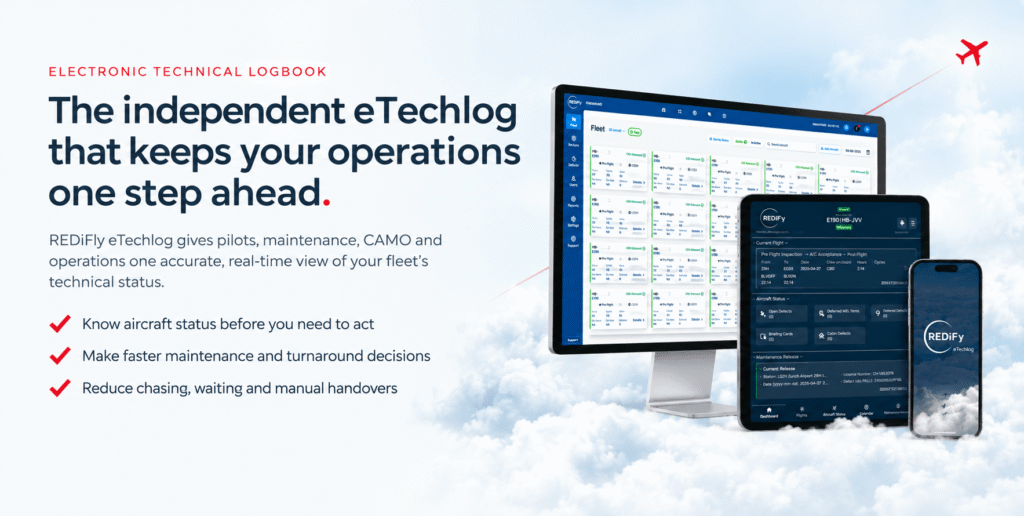
REDiFly takes this approach by supporting one-way and two-way integrations with MRO, CAMO, flight operations and other airline systems. For CAMO, the objective is to work from current hours, cycles, MEL status and structured technical records without repeatedly re-entering information that has already been captured at the aircraft.
You can see more of the integration and CAMO capabilities on the REDiFly eTechlog product page.
4. How disconnected records make aircraft status harder to track
Manual data transfer creates another problem beyond workload: different systems can be updated at different times.
The crew may have one view of the aircraft, while maintenance, the MRO system and CAMO have been updated at different times. When those sources do not move together, the challenge is no longer finding information. It is determining which information is current.
When those sources do not move together, simply finding information is not enough. The team first has to establish which version is current.
This can become particularly difficult across larger fleets, multiple stations and repeated handovers. The issue is no longer retrieving a particular technical-log page. It is maintaining a reliable picture of technical status across an operation that continues to move while the records are being processed.
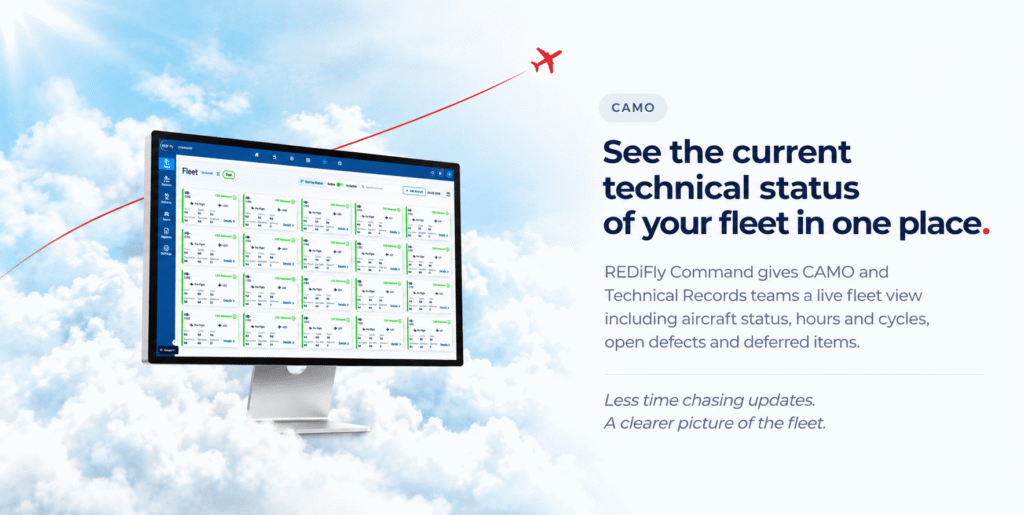
A connected eTechlog helps by creating a common operational record from which the relevant information can be made available according to each user’s role.
A pilot may need to see open defects, deferred MEL items and maintenance-release status before accepting an aircraft. MCC needs visibility of new inbound defects. CAMO may need current hours, cycles, MEL information and the associated technical history.
Those teams do not need the same interface or the same permissions. They do need their decisions to be based on the same underlying aircraft status.
Across larger fleets, multiple stations and repeated handovers, that becomes harder to manage. CAMO needs a reliable technical-status picture even while the operation continues to move.
5. How an eTechlog improves technical-record traceability
The impact of paper continues long after the flight is complete.
During an audit, airworthiness review, investigation or aircraft transfer, the team may need to reconstruct the history behind a technical event. Finding the original log page is often only the start. They may also need to confirm who made the entry, what maintenance followed, whether the item was deferred or corrected, and how it relates to records held elsewhere.
Paper can meet regulatory requirements, but maintaining and retrieving that history can create significant work.
With structured electronic records, entries can be retained with timestamps, signatures, maintenance actions and supporting information, making the technical history easier to retrieve and follow when needed.
For Technical Records teams, this removes some of the hidden workload that often appears long after the operation has moved on.
Technical Records should preserve the history of the aircraft, not have to reconstruct it later.
6. How structured eTechlog data supports reliability and planning
There is also value in the technical record long after an individual sector is complete.
Every flight adds utilisation data. Every reported defect adds another piece of information about fleet performance. Every deferred item and maintenance action contributes to the technical history of the aircraft.
With paper, much of this information begins life as an individual record. Before it can contribute meaningfully to fleet-level analysis, it first has to be transferred into a form that can be searched, grouped and compared.
An eTechlog allows that information to be captured as structured data from the beginning.
For CAMO and engineering teams, this can provide a cleaner foundation for recurring-defect analysis, reliability reporting, utilisation monitoring and maintenance planning. It can make it easier to look across aircraft rather than treating every technical-log entry as an isolated event.
This does not mean an eTechlog delivers predictive maintenance on its own. Reliability and predictive capabilities depend on the airline’s wider systems, engineering expertise, data sources and processes.
The eTechlog’s role is more fundamental: provide better source data for those processes to work with.
Paper records what happened. Structured operational data makes it easier to understand what keeps happening.
This CAMO benefit sits within a much wider business case for eTechlog adoption. We explore that in more detail in 7 Operational and Business Outcomes of a Successful eTechlog Implementation.
What should an eTechlog actually change for CAMO?
For CAMO, the strongest business case is not simply that the paper technical log disappears.
The change should be visible in the way the team works.
Aircraft information should reach CAMO sooner. Fewer records should require correction. Less data should have to be manually transferred between systems. Current aircraft status should be easier to establish, and the technical history should be easier to retrieve when it is needed.
A successful eTechlog implementation should also fit into the maintenance environment that already exists rather than creating another isolated system for CAMO to manage.
That leads to a more useful question when evaluating an eTechlog.
Instead of asking only, “Can this replace our paper technical log?”, ask:
What happens to the information after the crew enters it?
That is where much of the real CAMO value is created.
How REDiFly eTechlog supports CAMO
REDiFly eTechlog is designed to connect the aircraft with the wider operation.
Technical information captured by crews and engineers becomes part of a structured operational record that can be shared with CAMO, MCC, maintenance and connected airline systems.
For CAMO, that means earlier visibility of hours, cycles, defects and MEL status, with structured workflows and validation helping improve data quality at source.
REDiFly also integrates with existing MRO and CAMO systems rather than replacing them, allowing information to move into the maintenance environment while established system ownership remains in place. Time-stamped records also support retrieval, oversight and audit preparation.
The objective is simple: give CAMO better information from the aircraft, earlier, without creating another disconnected process.
Give your teams the info they need while there is still time to act
Paper technical logs can record what happened to an aircraft.
A connected eTechlog can make that information usable while the operation is still moving.
For CAMO and Technical Records teams, that can mean fewer records to reconcile, less information to re-enter, improved traceability and a more current picture of the aircraft being managed.
If your team is still spending time chasing technical-log information, correcting entries or manually transferring data between the aircraft and your maintenance systems, REDiFly can help you look at where those gaps exist today and what a connected workflow could look like instead.
See how REDiFly eTechlog can connect the aircraft technical record with your existing CAMO and maintenance environment.
Book a personalised eTechlog demo with our team.