
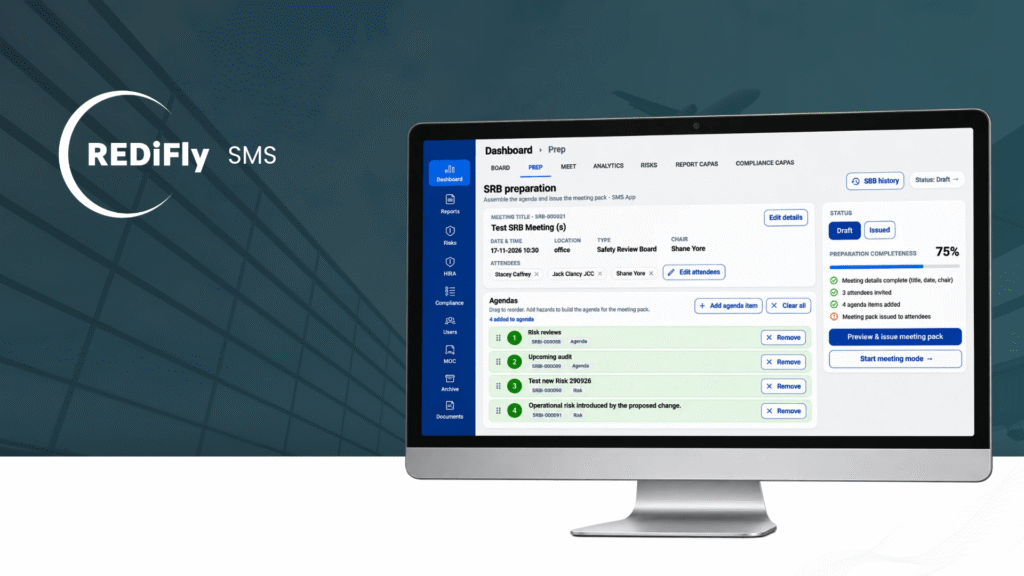
The work behind an effective Safety Review Board (SRB) starts well before the meeting, and what happens afterwards is just as important.
For Safety Managers, this involves bringing together the right information and ensuring that management discussions focus on significant operational risks. Decisions made during the meeting then need to be followed through.
When reports and risk assessments remain connected to their associated actions, preparation becomes easier and the organisation gains a clearer view of progress between reviews.
The Role of the Safety Review Board
Whatever the forum is called within an organisation, its role in the Safety Management System (SMS) is to provide senior management with oversight of safety performance and significant operational risks, including the effectiveness of existing controls.
Reviewing safety performance indicators (SPIs) and monitoring corrective actions are important parts of this responsibility, but neither tells the full story on its own. SPIs become more meaningful when considered alongside occurrence trends and the associated risk assessments. Investigation outcomes and evidence of control effectiveness provide further context.
The real value of an SRB comes from using this information to challenge assumptions and determine where management intervention is needed.
An effective SRB goes beyond reviewing dashboards or outstanding actions. It should help senior management understand whether the organisation’s most significant risks remain adequately controlled and where additional resources may be required.
Building a Clearer Picture of Operational Risk
One of the main challenges for Safety Managers is bringing together the information needed for an effective management review. Occurrence reports may be held in one system, while risk assessments and corrective actions are managed elsewhere. This can make it difficult to understand how individual events relate to wider operational risks.
This challenge is becoming increasingly relevant as aviation safety management standards evolve. The third edition of ICAO Annex 19 incorporates Amendment 2, with provisions becoming applicable on 26 November 2026. These include an increased emphasis on developing safety intelligence to support aviation decision-making. We explore these developments in more detail in our article on what ICAO Annex 19 Edition 3 means for aviation safety management.
For operators, this reinforces the importance of understanding how individual reports relate to wider operational risks and the controls in place, rather than reviewing events in isolation.
Consider an airline experiencing repeated ground handling incidents during aircraft turnarounds. Each occurrence may be investigated and closed at station level, and each may appear manageable on its own. When similar incidents emerge across several stations, however, they may point to weaknesses in training or procedures. Gaps in contractor oversight or equipment-related issues may also be contributing factors, as could pressure to achieve turnaround times.
The issue for the SRB is whether these occurrences indicate a wider operational risk and whether previous mitigation measures have reduced the level of exposure. Answering this requires visibility of earlier investigations alongside the associated risk assessments and controls already introduced.
Effective SRB preparation involves identifying which issues warrant management attention. Emerging trends and outstanding actions need to be considered alongside significant risks, with enough supporting evidence to explain why an issue matters.
A focused agenda allows management to understand the priorities ahead of the meeting, leaving more time for meaningful discussion and decision-making.
Turning Safety Information into Management Decisions
Management discussions should focus on the significance of the risks presented and whether further intervention is needed. Where concerns are identified, the SRB can consider additional mitigation measures or decide whether more resources should be allocated.
The number of investigations completed or corrective actions closed can provide useful measures of safety activity. However, these figures alone cannot establish whether the underlying risks are being adequately controlled.
Management needs to consider whether previous actions have delivered the intended reduction in risk. This requires an understanding of the issue’s history and the measures already introduced, supported by evidence of their effectiveness.
A productive SRB should lead to clear decisions. In some cases, management may determine that the current level of risk is acceptable within the organisation’s established criteria. Other situations may require further investigation or additional mitigation measures, potentially involving resources from several departments.
Whichever course is taken, the rationale should remain traceable. When an issue returns to a later SRB, management should be able to see what was known at the time and why a particular decision was made. There should also be a clear record of the actions taken and whether they achieved the intended result.
Access to supporting information is equally important during the meeting itself. When questions arise about previous occurrences or the effectiveness of a mitigation measure, management should be able to examine the relevant evidence without interrupting the discussion to retrieve information from elsewhere.
Having this context available keeps discussions focused and provides a stronger basis for determining the next course of action.
Maintaining Accountability and Measuring Effectiveness
The effectiveness of an SRB also depends on how management decisions are followed through.
Agreed actions need clear ownership and appropriate deadlines. Progress should remain visible so that outstanding work can be addressed before it develops into a further concern.
Completing an action, however, does not necessarily demonstrate that the underlying risk has been effectively controlled.
The FAA’s approach to SMS, set out in 14 CFR Part 5 and Advisory Circular 120-92D, makes an important distinction between Safety Risk Management and Safety Assurance.
Safety Risk Management establishes the processes for identifying hazards and putting appropriate risk controls in place. Safety Assurance focuses on monitoring performance and assessing whether those controls remain effective.
Closing a corrective action demonstrates that an activity has been completed. Assessing its effectiveness requires the organisation to go further and establish whether the control is producing the intended safety result.
Depending on the nature of the risk, this may involve reviewing subsequent occurrence trends or conducting targeted operational observations. Audit findings and changes in assessed risk levels can provide further evidence.
Establishing how effectiveness will be assessed when actions are agreed gives Safety Managers a clearer basis for evaluating the results and reporting back to management.
It is also important to recognise that closing an occurrence does not necessarily mean the underlying risk has been resolved. Maintaining the connection between original occurrence reports and subsequent risk assessments supports longer-term follow-up. The actions taken and supporting evidence remain part of the issue’s history, allowing the Safety Manager to establish what has changed since the previous review.
This becomes particularly valuable when preparing subsequent SRBs. Management can revisit significant risks with a clear record of earlier decisions and the progress made, maintaining continuity between meetings.
Keeping Safety Information Connected with REDiFly SMS
REDiFly SMS is aviation safety management software designed to support the processes and responsibilities that underpin an airline’s wider Safety Management System.
One of its key strengths is the way information remains connected throughout the reporting and risk management process. An occurrence report can be linked to its investigation and any associated risk assessment, with assigned actions and supporting evidence retained within the relevant records.
Importantly, occurrence reports and their associated risks can follow separate but connected workflows. An individual report may be investigated and closed, while the underlying risk continues to be managed through longer-term mitigation measures.
Where multiple occurrence reports relate to the same risk, REDiFly allows Safety Managers to review the associated records and examine the actions already taken. Previous investigations and mitigation measures remain accessible, making it easier to recognise recurring issues and establish how the risk has developed over time.
For airlines managing safety information across multiple departments or operational locations, this provides a clearer picture of developing risks and reduces the administrative work involved in investigating recurring concerns.
Supporting SRB Decisions and Follow-Up
The benefits of connected safety information become particularly valuable when preparing for a Safety Review Board.
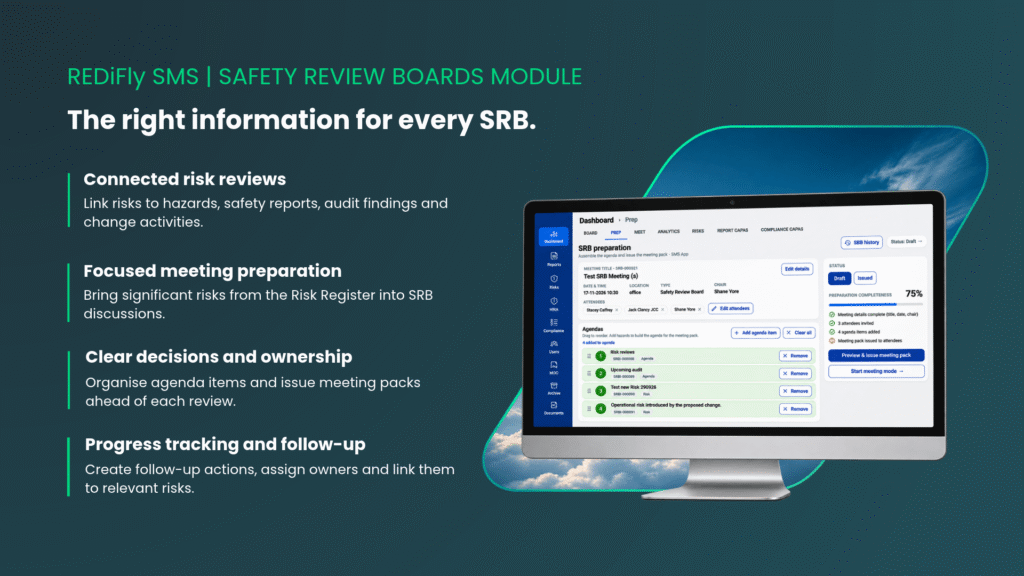
Once a Safety Manager identifies a risk that requires management attention, they can add it directly from the risk register to the SRB agenda with a single click. The risk and its associated records remain available for review, removing the need to recreate the information in a separate meeting document.
During the meeting, attendees can open a risk directly from the SRB agenda and examine the information behind it. This includes linked occurrence reports, existing mitigation measures and previous effectiveness checks. Initial and current risk assessments provide further context, allowing management to explore specific concerns as they arise and make better-informed decisions.
Further actions can be agreed and assigned within the SRB process, remaining connected to the relevant risk records. Responsibilities and deadlines are recorded, allowing Safety Managers to monitor progress after the meeting.
When the issue returns for review, the history of previous decisions and outstanding actions is already available. Management can see what has been done and consider whether further intervention is necessary.
For Safety Managers, this creates a more efficient process from preparation through to follow-up. Senior management benefits from access to the full context behind the risks being discussed, supporting more informed decisions and stronger oversight.
From Safety Oversight to Continuous Improvement
The effectiveness of an SRB ultimately depends on the quality of the information available and what the organisation does with it.
Connected safety information supports continuous safety assurance by preserving the relationship between operational events and the risks identified. It also keeps management decisions connected to the actions taken and the evidence used to assess their effectiveness.
By maintaining these connections, REDiFly SMS helps organisations develop a clearer understanding of operational risk and follow through on management decisions.
This gives Safety Managers more time to focus on the issues requiring attention, while senior management gains greater visibility of whether the organisation’s most significant risks are being effectively controlled.
Looking to improve how your organisation manages aviation safety?
Book a call with our team to discuss your safety management needs and explore how REDiFly SMS can support your operations, from occurrence reporting and risk management to more effective Safety Review Boards.