
If you’re responsible for safety management at an airline, Part-145 MRO, or CAMO, you’ve probably already heard that ICAO Annex 19 has been updated. Amendment 2 was adopted in June 2025, became effective in November 2025, and is incorporated into Annex 19 Edition 3. The revised provisions become applicable on 26 November 2026.
What you may not have heard, or at least not had spelled out clearly, is what this actually means for how your aviation safety management system operates in practice. Because this isn’t simply a documentation update. The revised Annex places greater emphasis on safety intelligence: how safety information is collected, analysed and used to manage risks and support informed decisions.
What Is ICAO Annex 19 Edition 3 and What Changed in 2026?
ICAO Annex 19 sets out the international standards for aviation safety management. Published by the International Civil Aviation Organization, it provides the framework for State Safety Programmes and Safety Management Systems (SMS) across the aviation industry, including airlines, maintenance organisations, aerodromes and other service providers.
The third edition incorporates Amendment 2, a significant update to the Annex since its introduction in 2013. It strengthens existing SMS provisions, extends their applicability to certain remotely piloted aircraft operators, associated maintenance organisations and certified heliports, and places greater emphasis on the development of safety intelligence.
For operators and maintenance organisations already using an SMS, the key development is the increased emphasis on how safety information is collected, analysed and used to support decisions. Effective risk management and safety performance monitoring are not new requirements, but Edition 3 reinforces their importance in an increasingly data-driven approach to safety management.
To support this, ICAO has published a new Safety Intelligence Manual, Doc 10159, providing guidance on how organisations can collect, process, analyse and use safety information to identify risks, monitor trends and support better-informed decisions.
Put simply: the important question isn’t just whether you have an SMS. It’s whether the information it produces is helping you manage safety.
The Change That Actually Matters
Most of the commentary around ICAO Annex 19 Edition 3 has focused on expanded applicability — RPAS operators, certified heliports, and so on. That matters for those sectors, but for aircraft operators and Part-145 organisations who already have an SMS requirement, the more important shift is subtler and considerably more demanding.
ICAO has moved the standard for a compliant SMS from having one to proving it works.
The third edition puts formal weight on safety intelligence, measurable safety performance indicators (SPIs), and the ability to show that your SMS is actively shaping decisions across the organisation, not just sitting in a manual on a shared drive. Doc 10159 makes the direction clear: organisations need to move beyond collecting safety data toward making sure it’s trustworthy, contextualised, and actually acted on.
Your SMS needs to show its work.
EASA has been heading this way for a while. Their Management System Assessment Tool, the framework EASA inspectors use when they evaluate your SMS, states directly that “being compliant with the requirement does not necessarily mean being safe” and that assessors must look at the difference between compliance and performance. That’s not new language. But the November 2026 deadline gives it real teeth for organisations that still haven’t closed that gap.
What "Operational" Actually Looks Like
There’s a distinction that comes up constantly in the safety world: the gap between a documented SMS and an operational one.
A documented SMS ticks the right boxes on paper. If an auditor shows up and asks to see the manual, you can hand it over.
An operational SMS is something different. It’s one where frontline staff are actually submitting reports — regularly, confidently, without friction. Where hazards are assessed and recorded in a live risk register. Where CAPAs are assigned, tracked, and closed with evidence of the actions taken and their effectiveness. Where management is getting meaningful safety data and doing something with it. Where, if an inspector asks to see how a specific hazard evolved over the past six months, you can pull that up in five minutes, not spend an afternoon piecing it together from three different spreadsheets.
That expectation isn’t new, and Annex 19 Edition 3 doesn’t prescribe a particular software system. But its greater emphasis on safety intelligence makes the practical question more relevant than ever: if you’re running your SMS on spreadsheets, shared folders and email chains, how easily can you demonstrate that it’s working?
Can you follow the evidence?
How safety information supports action, informed decisions and continuous improvement.
Illustrative SMS cycle: activities can overlap and do not represent a prescribed ICAO workflow.
Safety information captured
What was reported, when, and through which channel?
- Report record
- Date and reporting source
- Supporting details
Hazards and risks evaluated
What hazard or risk was identified and assessed?
- Risk assessment
- Identified hazards
- Controls and mitigations
Actions and mitigations tracked
Who owns the action, and how is progress tracked?
- Action log
- Owner and due date
- Progress and evidence
Trends and effectiveness reviewed
Are controls effective? What do trends and SPIs show?
- SPI and trend analysis
- Effectiveness checks
- Emerging risks
Management decisions and follow-up
What was decided, and what happens next?
- Management / SRB records
- Decisions and actions
- Follow-up status
Where Your Current SMS Tools May Be Falling Short
This is where the conversation tends to get a bit uncomfortable.
Spreadsheets and email-based safety management don’t fall short because the people running them aren’t capable or committed. They can fall short because the tools themselves make a genuinely operational SMS harder to sustain. We’ve looked at the hidden administrative burden of spreadsheet-based safety management before, but with Annex 19 Edition 3 becoming applicable in November 2026, it’s a timely opportunity to examine where these systems may be creating gaps.
Think about what actually happens day to day. A report arrives by email and sits in an inbox. The hazard doesn’t reach the risk register until someone manually moves it across. The CAPA lives in a separate document with no reminders, no escalation, no automatic trail. The audit record — who approved what, when, and why — exists only if someone remembered to save the right version of the right file at the right time.
Safety performance indicators (SPIs), alert thresholds, trend analysis and evidence of management reviews are already important elements of effective safety management. Annex 19 Edition 3 reinforces the wider importance of using this information to support decisions. While fragmented, manual systems can produce the necessary evidence, doing so consistently often requires considerable administrative effort. Even aviation SMS software can create similar challenges when reporting, risk management and compliance processes remain disconnected.
EASA’s existing assessment framework already distinguishes between documented processes and demonstrated effectiveness. The question isn’t simply whether your organisation has the required procedures in place. It’s whether you can show how safety information moves through the system, what actions were taken and whether those actions were effective.
Why Reporting Culture Matters More Under Annex 19 Edition 3
There’s another dimension to this that experienced safety managers already know, but that can get lost in discussions about data and performance.
Good safety intelligence depends on people being willing to report.
Annex 19 Edition 3 places greater emphasis on developing safety intelligence from the information organisations collect. Occurrence reports, near-miss observations and hazard identifications are all valuable sources of data that can be analysed for trends and emerging risks. If frontline staff aren’t reporting, important warning signs may never reach the system. You’re measuring silence, not safety.
Reporting culture is shaped by leadership, trust, Just Culture, and how people feel their reports will be used. Protecting reporting sources and encouraging a positive safety culture are already established principles of aviation safety management. But as organisations look to make better use of safety intelligence under Edition 3, these foundations become even more important. You can’t mandate that culture into existence. But you can make it easier or harder through the tools you put in front of people.
When submitting a report takes fifteen minutes, involves a clunky form, or disappears into an inbox with no visible outcome, people quietly stop doing it. Not because they don’t care, but because the process tells them it doesn’t matter. Organisations are better positioned to make use of safety intelligence when reporting is straightforward, accessible, and people can see that their contributions lead to meaningful action.
If your tools make reporting difficult, you’re not just failing a usability test. You’re weakening one of the foundations of an effective SMS: the safety information it needs to identify risks and support better decisions.
What Regulators Will Actually Ask For
Here’s what demonstrating SMS effectiveness looks like in practice, because it’s more concrete than it might sound.
When an inspector or national authority auditor sits down with your safety team, questions may include:
Can you show how a specific hazard was identified, assessed and mitigated, who was responsible, and how the effectiveness of those mitigations was reviewed?
What are your current safety performance indicators (SPIs), and can your management review or Safety Review Board records demonstrate how safety trends are assessed and acted upon?
How does safety data from frontline reporting reach the people responsible for making decisions at management level?
Can you give examples of actions or operational cha
The Clock Is Running
November 2026 is fast approaching. With ICAO Annex 19 Edition 3 reaching its formal applicability date on 26 November, now is a good time for aviation organisations to review how effectively their safety management systems are operating. For teams already subject to SMS requirements, the question is whether safety information is being collected, assessed and used to support decisions, and whether the evidence is readily available when needed.
EASA recognises that SMS maturity develops over time. Its Management System Assessment Tool evaluates whether processes are present, suitable, operating and effective, recognising the difference between documented procedures and demonstrated performance. Building an effective SMS takes time, particularly for lean safety teams working with fragmented systems or moving away from spreadsheets and email-based processes.
A useful starting point for any lean safety team is an honest self-assessment, not against the ideal, but against what an inspector would actually find tomorrow. What could you demonstrate immediately? What would take time to pull together? What simply doesn’t exist yet in any traceable form?
How to Assess Your SMS Readiness for ICAO Annex 19 Edition 3
If you’re taking stock of your SMS in light of Annex 19 Edition 3, these are the questions that cut to it:
Can your team submit reports in the field, quickly and without friction? If reporting takes too much effort, important safety information may never reach the people responsible for assessing it.
Is your risk register up to date and connected to your reports? If reported hazards are sitting in an inbox before anyone assesses them, you’re creating gaps in the information your safety team relies on.
Can you demonstrate CAPA traceability? Not just that actions were completed, but who owned them, when they were due, what changed, and how you verified they were effective.
Can you retrieve audit-ready evidence in minutes, not hours? If every inspection means searching through emails and reformatting spreadsheets, that’s a problem worth addressing.
Are your SPIs supported by reliable, up-to-date safety data? Or are they assembled manually from multiple sources, making trends harder to identify and results more difficult to explain?
Can you show that reporting sources are protected? A positive reporting culture depends on trust. Appropriate access controls, confidentiality safeguards and anonymous reporting options where relevant can help people feel confident contributing safety information.
If several of those answers are no, the issue may not be how hard your team is working. It may be the processes and tools they’re working with.
What a Connected SMS Looks Like in Practice
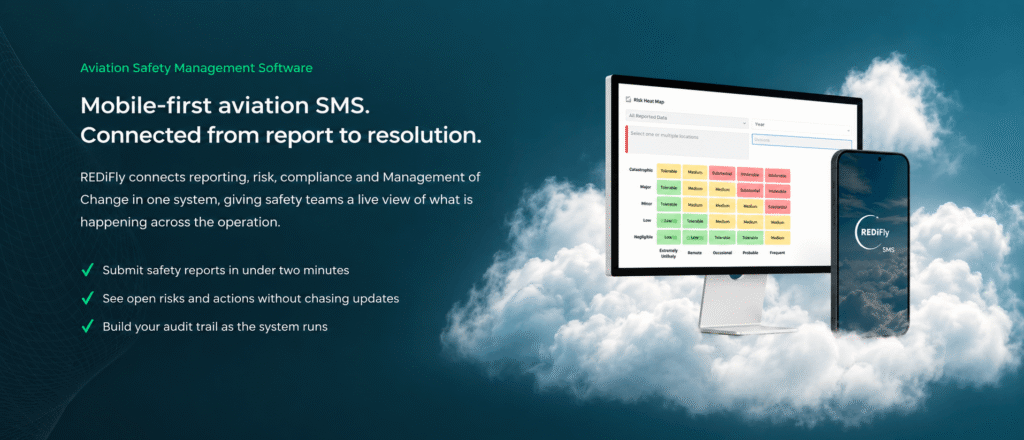
It’s worth being specific about what this looks like in practice, because it maps closely to how we built REDiFly SMS.
On reporting: Crews shouldn’t need to be at a desk or searching for the right form. Reports should be easy to submit from a mobile device, with structured information that safety teams can assess and act on. Anonymous reporting options can also help encourage participation and support a positive reporting culture.
On risk: Individual reports are only one part of the picture. A connected SMS should allow reported hazards to be assessed within a live risk register, with mitigations assigned to named owners, clear due dates and residual risk monitored over time. Without that visibility, it’s easy to end up logging risks rather than actively managing them.
On compliance and audits: Bringing audit findings, hazards and corrective actions together makes it easier to maintain a clear, traceable record. When findings and CAPAs are connected, with ownership, timestamps and supporting evidence, safety teams spend less time preparing for audits and more time addressing the issues identified.
On management of change: Safety risk management shouldn’t be limited to responding to incidents. A structured Management of Change (MoC) process allows organisations to identify the safety implications of operational changes, assess associated risks, assign responsibilities and track actions through to completion.
The common thread is connection. Effective aviation compliance software can bring reporting, risk management, audits and change management together, rather than leaving safety teams to bridge separate systems manually. That makes safety information easier to access, analyse and use in decision-making, supporting the wider emphasis on safety intelligence reinforced by Annex 19 Edition 3.
From SMS Compliance to Demonstrated Effectiveness
ICAO Annex 19 Edition 3 doesn’t introduce the idea that an SMS should be effective. Safety professionals have understood the gap between documented procedures and operational safety management for a long time. It comes up at every conference, in every honest post-audit conversation.
What the revised Annex does is reinforce that direction, placing greater emphasis on safety intelligence and how information is used to support decisions. With the 26 November 2026 applicability date approaching, it’s a timely opportunity to ask whether your SMS is delivering on those principles. Whether data flows through it, not just into it. Whether it’s genuinely shaping decisions, not just recording what happened.
Most safety teams already know where their processes work well and where improvements are needed. The question is whether their existing tools and workflows make it easy to demonstrate those outcomes. Addressing those gaps isn’t just about preparing for the next inspection. It’s about making safety management more effective every day.
REDiFly SMS is aviation safety management software built for aircraft operators and Part-145 organisations. Reporting, risk management, compliance and management of change are brought together in one connected system, helping safety teams track issues through to resolution and provide management with a clearer picture of safety performance.
If you’d like to see how it works in practice, book a demo and we’ll walk you through it.